

Toxicogenomic signatures, ready to compare
An open repository of the genes that go up and down after exposure to a chemical or an environmental factor. Curated, anchored to reference ontologies, and queryable across species, tissues and compounds.
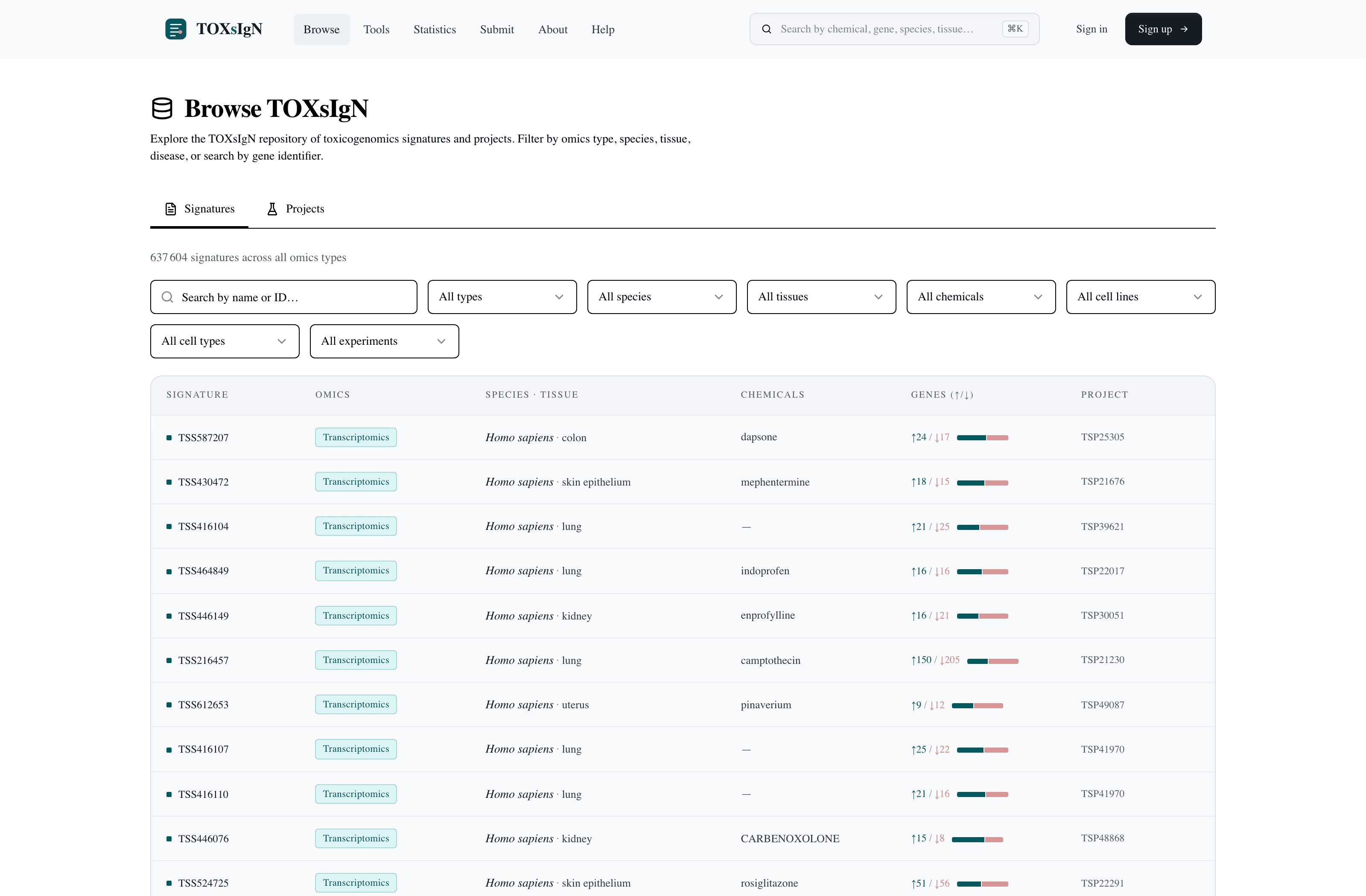
- 637,604
- Signatures
- 49,173
- Projects
- 4,774
- Compounds
- 4
- Species
Five omics layers, one comparable format
Whatever the assay, a signature reduces to the same thing: a set of identifiers that went up, a set that went down, and the set that was interrogated. That is what makes two experiments from different labs comparable at all.
Genomics
- Accepted identifiers
- Entrez, Ensembl
Transcriptomics
- Accepted identifiers
- Entrez, Ensembl
Epigenomics
- Accepted identifiers
- Entrez, Ensembl
Proteomics
- Accepted identifiers
- UniProt AC/ID, gene symbol, ENSP, RefSeq, IPI
Metabolomics
- Accepted identifiers
- HMDB, ChEBI, KEGG, PubChem CID, InChIKey
The public corpus today is almost entirely transcriptomic. That reflects what the community has deposited, not a limit of the platform.
Species in the public corpus
- Homo sapiens630,334
- Rattus norvegicus7,116
- Mus musculus153
- Drosophila melanogaster1
Metadata you can query on
Species resolve to NCBI Taxonomy, compounds to ChEBI with their CAS number, PubChem CID, InChIKey and SMILES, diseases to the Disease Ontology. Projects carry the PubMed ID of the publication and a cross-link to the raw data in GEO.
Every project, assay, condition and signature gets a permanent accession, so a result you cite today still resolves later.
Built for the questions toxicologists actually ask
Not just a place to park gene lists. The repository is designed so that one signature can be interrogated against every other one.
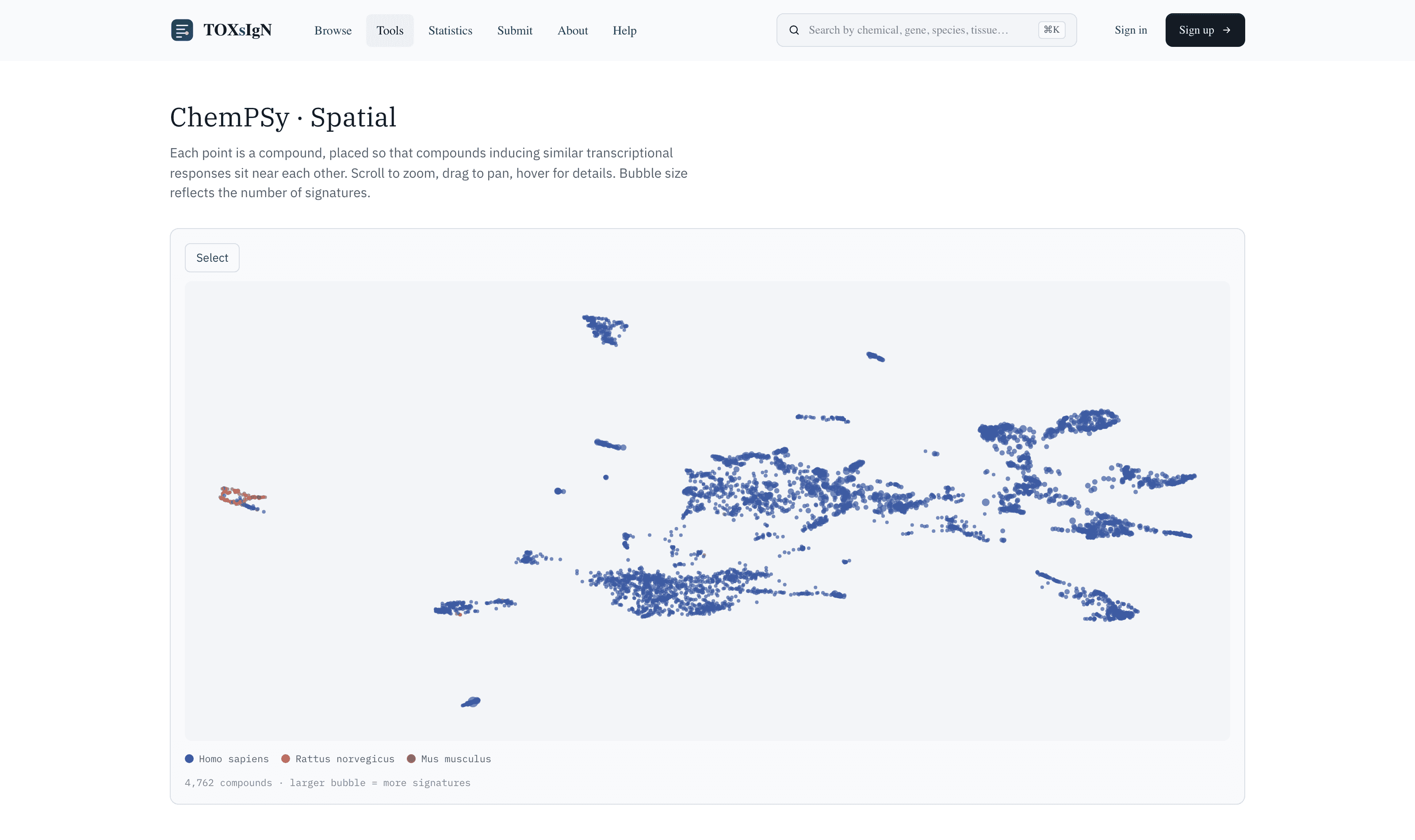
A map of chemical space
Compounds placed by how cells actually respond to them, not by molecular structure. Neighbours are candidates for read-across; box-select a cluster and drop straight into a filtered browse.
Across species
For a compound tested in more than one organism, see which genes respond the same way, which respond oppositely, and which only move in one species. The concordance question, answered with data.
Yours to take away
Facets that know what exists
Filters are built from the data itself and carry their counts, so you never select a combination that returns nothing. Several compounds can be queried at once.
Start from a gene, not a study
Ask which signatures contain a given gene and whether it moves up, down, or both depending on the exposure. The reverse of the usual lookup, and often the more useful direction.
Linked to Adverse Outcome Pathways
Signatures are matched to AOP-Wiki through their chemical stressor, by CAS number first and by name as a fallback, and curators review the links.
Interpretation in place
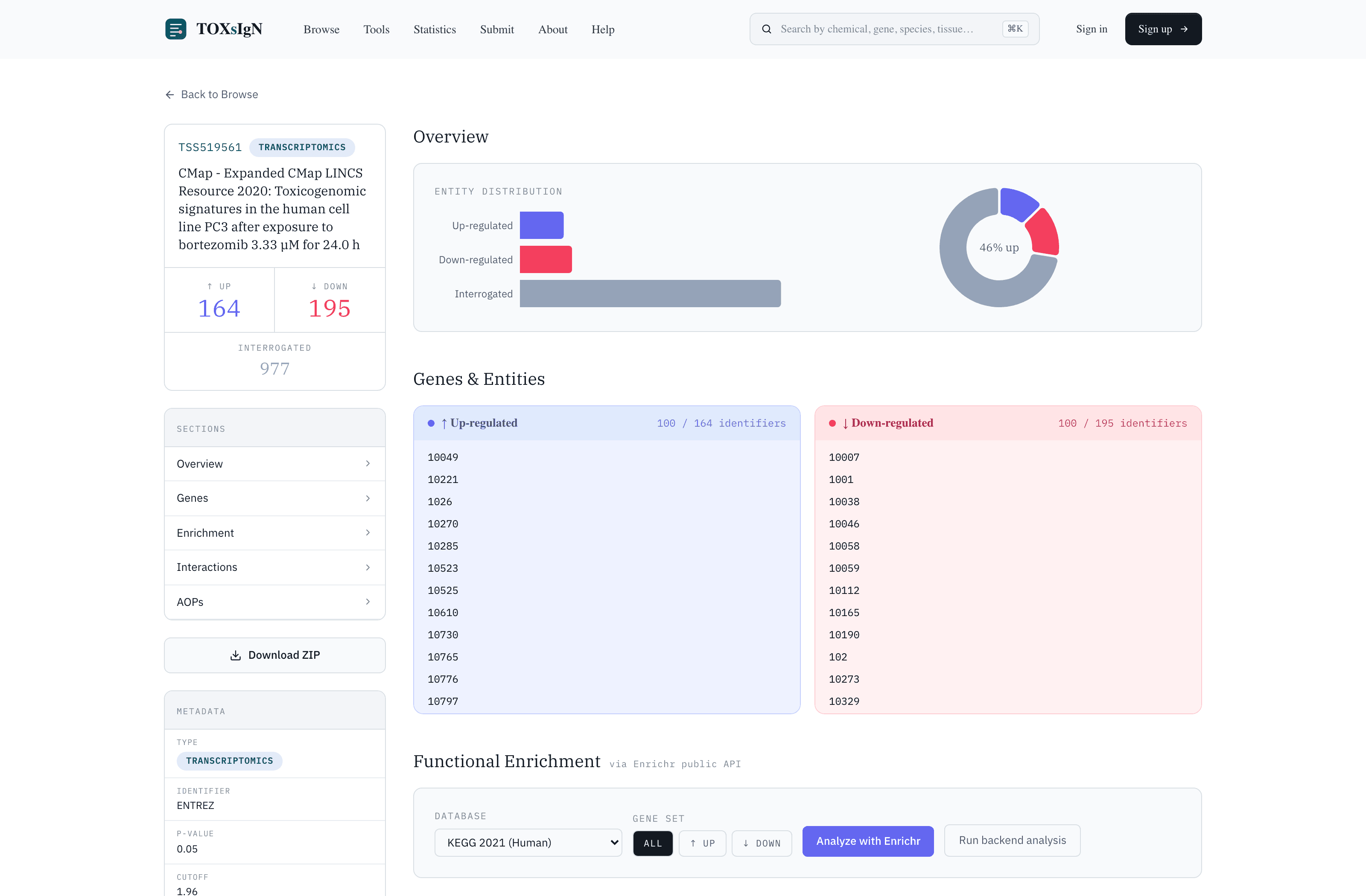
Functional enrichment against GO, KEGG, Reactome, WikiPathways and MSigDB Hallmarks, and protein interaction networks from STRING, run from inside a signature.
One box for everything
A single query searches projects, signatures, genes, proteins and metabolites at once and groups the hits by what they are.
From a question to a comparable answer
Search the repository
Filter by omics type, species, tissue, disease, cell line and exposure type, combine several compounds at once, or search directly by gene identifier to find every signature a gene appears in.
Inspect a signature
Up-regulated, down-regulated and interrogated entity counts, the full identifier lists deep-linked to NCBI Gene, Ensembl, UniProt, HMDB, ChEBI, KEGG and PubChem, plus the exposure that produced them: dose, duration, route and vehicle.
Compare against everything else
Start from a deposited signature or upload your own gene list. The repository ranks its signatures by directional overlap, separating concordant from opposite responses, with orthologue matching if you want to cross species.
Run the tools on your query
Every tool takes the same three inputs: a signature accession, an uploaded list, or the query you just built in the browser. No export and re-import loop between steps.
One dataset, several instruments
Each tool takes a deposited signature, a gene list you upload, or the query you built while browsing.
Similar signatures
Rank the repository against your query by directional gene-set overlap, separating concordant from opposite responses.
1 signature or gene list → overlap, score, p-value
Compare signatures
Take a set of 2 to 25 signatures and read their pairwise directional connectivity as a similarity heatmap.
2–25 signatures → similarity matrix
Cross-species
Pick a compound tested in more than one species and see which genes respond the same way, oppositely, or in only one species.
multi-species compound → conserved / divergent genes
AOP network
Explore the Adverse Outcome Pathways represented in the repository, connected wherever they share mechanistic Key Events from AOP-Wiki.
repository-wide → AOP graph
ChemPSy · Spatial
Project compounds into a two-dimensional space built from their transcriptional responses, so chemicals that perturb cells alike sit together.
chemical space → box-select a cluster into Browse
ChemPSy · Prediction
Read across from a query signature to its nearest neighbours in that space to surface the Adverse Outcome Pathways most associated with them.
1 signature or gene list → ranked AOP evidence
Similarity is deliberately transparent: shared genes in the same direction count as concordant, shared genes in opposite directions as discordant, producing a signed connectivity score, a directional Jaccard index and a hypergeometric p-value for ranking. No hidden model.
Deposit on your own terms
Your data stays yours until you decide otherwise.
Create a project
Describe the study and link it to what already exists: a PubMed ID for the paper, a GEO accession for the raw data.
Describe the assay and the exposure
Species, tissue, cell line, in vivo or in vitro, then the compound with its dose, exposure time, frequency, route and vehicle. Metadata is bound to ontology terms rather than free text.
Deposit the entity lists
Up-regulated, down-regulated and interrogated identifiers, with the statistical thresholds you used. Each object receives a permanent accession.
Publish when you are ready
Projects are private to your account by default. When you ask for publication they go to a curator for review before they become part of the public corpus.
Three states, no ambiguity: private while you work, pending once you request publication, public only after a curator has reviewed it. Every public query in the platform filters on that last state, so unpublished work cannot leak into someone else's search results.
Where SciLicium fits in
TOXsIgN is built and maintained with the IRSET research unit (Inserm U1085) and the GenouEst bioinformatics platform at the University of Rennes, and promoted with Inserm Transfert. The same team runs our dedicated analysis and subscription services, which is why toxicogenomics work we take on can be interpreted against the repository rather than in isolation. Results produced in GenoLens can be compared to deposited signatures directly.